The $150,000 Terminal Tax Bomb

The mistakes most Canadians make on their RRSP, RRIF, and TFSA — and how to defuse it.

"It rolls over to your spouse tax-free" is true — and it's where almost every conversation stops. A spousal rollover defers the tax on your registered accounts. It never erases it. This book does the second-death math while there's still time to act on the answer.

Out now · Kindle & paperback · Written for Canadians 55+ with registered accounts
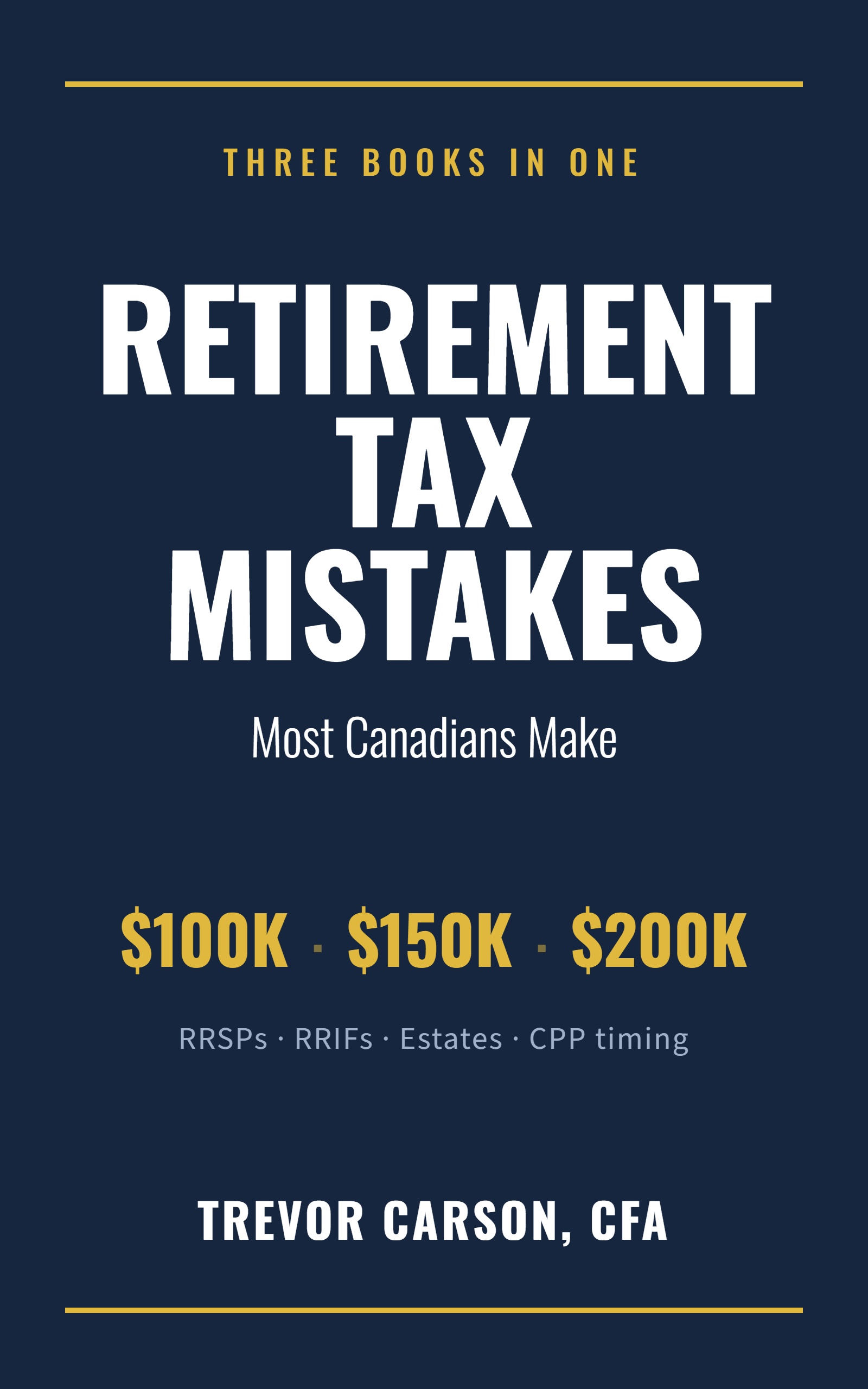
Book cover: The $150,000 Terminal Tax Bomb by Trevor Carson, CFA
Updated for 2026 Canadian tax rules Build your terminal tax plan in one afternoon Written by a CFA charterholder
The Problem

Canada Has No Inheritance Tax. It Taxes the Deceased Instead.

Nothing about an RRSP, RRIF, or LIF is ever actually tax-free at death. The liability has been building for decades — and three things determine whether your family sees it coming.

The Half-Truth

A Deferral, Not an Exemption

"It rolls over to your spouse tax-free" is accurate and, in the way it's usually left, dangerously incomplete. The rollover resets the clock. It doesn't stop it.

The Second Death

One Account, One Tax Year

When the surviving spouse dies, there's nobody left to roll the account to. The entire balance lands on a single terminal return, at rates approaching 50%, on money that took thirty years to build.

The Planning Gap

Between Two Competent Professions

Estate lawyers draft who-gets-what. Advisors plan accumulation and drawdown. The terminal tax projection sits precisely between "that's a legal question" and "that's after my engagement ends."

A spousal rollover is a deferral, not an exemption. The tax that has been building for decades doesn't disappear when a spouse inherits it. It waits.
— Chapter 1, The Myth of the Tax-Free Inheritance
Free Tool — No Sign-Up

Run the Number Before You Read the Book

The free calculator built for the first book models withdrawal sequencing across your RRSP, LIRA, TFSA, and non-registered accounts — including RRIF minimums, CPP and OAS timing, the OAS clawback, and terminal-year tax at death.

That last line is the one this book is about. If the terminal tax figure it produces is large enough to bother you, this book is written for you.

Open the Free Calculator →
What it shows you
Terminal tax at death — planned vs. unplanned$ saved
Projected registered balance at life expectancyto age 100
Estate value after tax, by strategyside by side
Year-by-year withdrawal schedulefull table
No email. No sign-up. Instant results.
What You'll Learn

What You'll Be Able to Do After Reading

You don't need to become a tax expert, and you don't need to replace your lawyer or advisor. You need to know which questions haven't been asked on your file.

1Foundation

Know What Each Account Does at Death

RRSP, RRIF, TFSA, LIF, non-registered investments, and the principal residence — at the first death, and separately at the second. The mechanics, not the platitudes.

2Five-Minute Fix

Get Every Beneficiary Designation Right

Naming a person versus naming your estate. Successor holder versus beneficiary. Which is correct for each account you hold — and what the wrong choice costs.

3Core Strategy

Project Your Own Terminal Tax Bill

Run the second-death number yourself, with your balances and a realistic return assumption, and see how much of your estate is currently unaccounted for.

4High Impact

Reduce the Number Before It Lands

Charitable designations, second-to-die insurance, accelerated withdrawals, and beneficiary structure — how they work, and why they work best in combination.

5Immediate Use

Ask Your Estate Lawyer the Right Ten Questions

Walk into the meeting knowing what a good answer sounds like — on rollovers, locked-in accounts, probate exposure, and terminal tax modelling.

6One Afternoon

Write Your One-Page Terminal Tax Plan

Account audit, second-death projection, action list with dates. A real written plan you can hand to an executor or revisit every January.

Inside the Book

Seven Chapters. The Whole Arithmetic, Worked Twice.

Written in plain language for Canadians who have saved carefully and would like more of it to reach the people they intended it for.

Every strategy is quantified. Every case study carries real numbers you can check against your own accounts.

CH 1
The Myth of the Tax-Free Inheritance
Why "it rolls over tax-free" is the most expensive half-truth in Canadian planning
CH 2
What Happens to Each Account When You Die
RRSP, RRIF, TFSA, LIRA and LIF, non-registered, and the principal residence exemption
CH 3
The Decisions That Determine Your Terminal Tax Bill
Beneficiary design, the qualifying survivor test, donation credits, insurance, trusts
CH 4
The Second Death — Where the Real Tax Bomb Sits
The full math on a $700,000 RRIF, run twice: with planning and without
CH 5
Age-by-Age — What to Do at 55, 65, and 75+
Which decisions are open now, which close permanently, and how to start at 78
CH 6
Build Your Terminal Tax Plan in One Afternoon
The account audit, the projection, and the one-page plan — plus provincial probate tables
CH 7
The Ten Most Expensive Estate Mistakes Canadians Make
A final checklist against your own accounts, with the fix for each one

The Numbers Behind the Second Death

Every figure in the book is grounded in Canadian tax mechanics you can reconstruct yourself. This is the magnitude of what sits unquantified in most estate plans.

$280K+
Tax owing at the second death on a $700,000 RRIF drawn only at the legal minimum
40–50%
Share of a registered account that can go to CRA in a single taxation year
$230K
Second-death bill one couple found sitting behind a $580,000 combined balance
$6,000
Avoidable Ontario probate on a $400,000 RRIF named to the estate instead of a person
Chapter 7 Preview

The Ten Most Expensive Estate Mistakes

None of these require complex planning or significant expense to correct. What they require is noticing them — which is exactly why they persist for decades inside otherwise well-run households.

×Naming the estate instead of a direct beneficiary on an RRSP, RRIF, or LIF
×Setting a spousal TFSA to "beneficiary" rather than "successor holder"
×Assuming the RRIF will shrink on its own after the first death
×Splitting a single RRIF across a spouse and children in an attempt to be fair
×Failing to use the charitable donation credit against RRIF income at death
×Buying individual rather than second-to-die insurance to fund the tax bill
×Never revisiting beneficiary designations after a divorce or remarriage
×Assuming a will alone controls what happens to a LIRA or LIF
×Treating estate planning as a legal-only exercise with no tax modelling
×Waiting until the second death is imminent to run any of these numbers
The Series

Two Halves of the Same Calculation

The first book reduces the tax you pay while you're alive. This one reduces what your family pays after. Both are out now — read either on its own, or both, in order.

The $100,000 RRSP Mistake cover Available Now

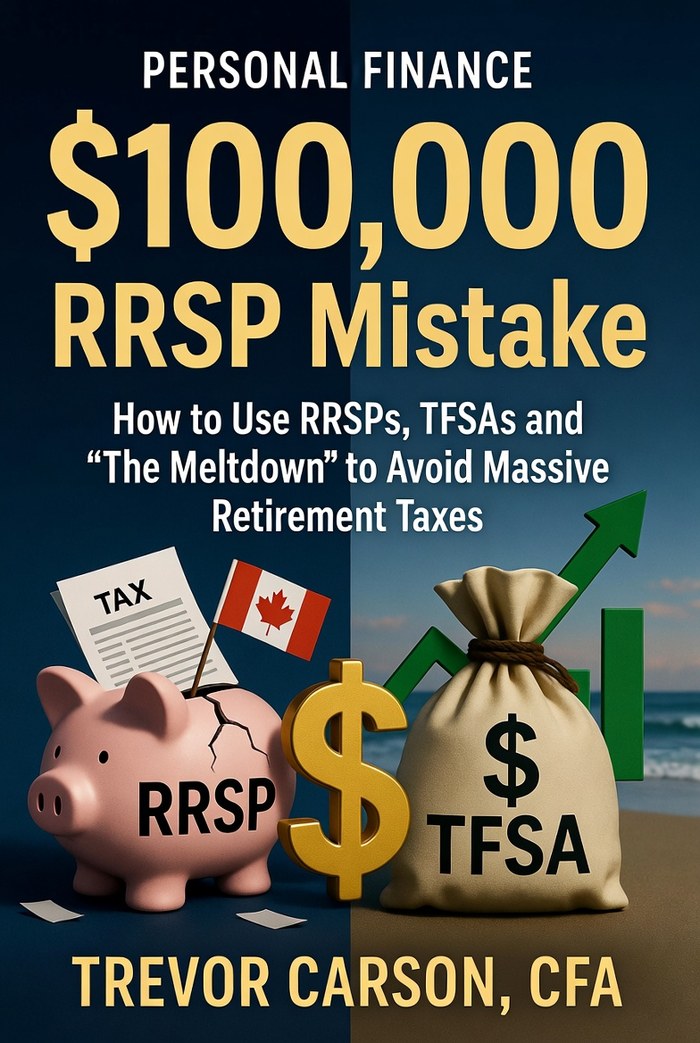
The $100,000 RRSP & RRIF Mistake

Withdrawal sequencing, the meltdown window, CPP and OAS timing, LIRA unlocking, and the OAS clawback — the drawdown decisions between 55 and 71.

Buy on Amazon.ca →
Kindle · Paperback · Audible
The $150,000 Terminal Tax Bomb cover Available Now

The $150,000 Terminal Tax Bomb

What the spousal rollover defers rather than erases — beneficiary design, the second-death projection, donation credits, and second-to-die insurance.

Buy on Amazon.ca →
Kindle · Paperback · You're on this book's page
Trevor Carson, CFA
About the Author

Trevor Carson, CFA

Trevor is a CFA charterholder based in Calgary, Alberta. He wrote his first book — and built the free calculator that accompanies it — because the drawdown side of retirement planning is where Canadian households lose the most money and get the least plain-language guidance.

This second book covers the gap that opens after that one closes. He isn't selling investment products, insurance, or advisory services. The books, the math, and the calculator are the whole offer.

FAQ

Frequently Asked Questions

Straight answers to what Canadians ask most about registered accounts, spousal rollovers, probate, and tax at death.

Is an inheritance taxable in Canada?

Canada has no inheritance tax, but it does tax the deceased. At death you are deemed to have disposed of your property at fair market value, and the full balance of an RRSP, RRIF, or LIF is added to income on the final return. Heirs receive what's left after that bill is paid — which is why the absence of an inheritance tax is so often misread as the absence of tax.

What happens to my RRIF when I die?

If your spouse is the named beneficiary or successor annuitant, the RRIF rolls over to them and no tax is triggered at that point. If there is no surviving spouse, the entire remaining balance is added to your income in the year of death and taxed in that single year — frequently at or near the top marginal bracket.

Is the spousal rollover really tax-free?

A spousal rollover is a deferral, not an exemption. The liability built up inside the account doesn't disappear when a spouse inherits it — it waits, and lands in full on the second death. An estate plan that stops at "it rolls to my spouse" has modelled half the problem.

What is the second-death problem?

The second death is when the surviving spouse dies and there's nobody left to roll the registered account to. The entire remaining RRIF or LIF balance is included in income in one taxation year. A $700,000 RRIF inherited at 72 and drawn only at the legal minimum can still owe more than $280,000 in tax at the second death eighteen years later.

Successor holder or beneficiary on a TFSA — what's the difference?

A successor holder designation, available only to a spouse or common-law partner, lets the TFSA continue as their own account with the tax-free shelter intact. A beneficiary designation requires the account to be collapsed: only the date-of-death value is protected, growth after that date is taxable, and re-sheltering the principal depends on meeting a filing deadline.

Should I name a beneficiary or my estate on my RRSP or RRIF?

Naming a person directly generally lets the account bypass probate; naming the estate routes it through probate along with everything else you own. In Ontario, a $400,000 RRIF named to the estate incurs roughly $6,000 in avoidable probate fees on that account alone. Alberta's flat fee makes the dollar stake far smaller, but the delay and creditor exposure still apply.

How does a charitable donation reduce tax at death?

In the year of death, donations can be claimed against up to 100% of net income, and the credit is worth roughly half the donated amount at top rates. Because a RRIF's deemed disposition is fully included in that same income, a charitable RRIF designation costs your heirs roughly fifty cents on each dollar given — the other fifty cents was headed to CRA regardless.

What is second-to-die life insurance?

A joint second-to-die policy pays out only when the second spouse dies, which matches the timing of the terminal tax liability it's meant to fund. Per dollar of coverage it's typically less expensive than two individual policies providing the same eventual benefit.

Does this apply to common-law partners?

Yes. The Income Tax Act's spousal rollover provisions, and most provincial pension legislation governing LIRAs and LIFs, apply equally to common-law partners meeting the applicable definition — typically cohabiting for a specified period, or having a child together. Confirm your relationship meets your province's definition if there's any ambiguity, but the mechanics don't change.

My RRIF is only $150,000. Does this still matter?

The mechanics apply at any size; the urgency scales with the balance. A $150,000 RRIF taxed as the only significant income in the year of death typically generates a bill in the $40,000–$50,000 range. That may not justify permanent insurance or trust structuring — but the beneficiary and successor-holder corrections cost nothing at any balance and are worth doing regardless.

Do I need to read the first book first?

No. Every concept this book depends on is explained from first principles. If you have read The $100,000 RRSP & RRIF Mistake Most Canadians Make, you can move quickly through Chapter 2 and start at Chapter 3 — the meltdown strategy in the first book and the second-death planning in this one are two halves of the same calculation.

Is this book legal or tax advice?

No. The book and the calculator are for general educational purposes and illustrate concepts using approximate figures. They are not a substitute for advice from a qualified estate lawyer, tax advisor, or financial planner familiar with your specific situation.

Every Strategy in This Book Needs Lead Time

The insurance window, the giving plan, the accelerated withdrawals, the beneficiary corrections — each one costs more and offers fewer options the longer it waits. The audit in Chapter 6 you can start this weekend.

The $150,000 Terminal Tax Bomb cover
Get the Book
Kindle & paperback · Amazon.ca
Buy on Amazon →
For informational purposes · Consult a qualified estate lawyer or advisor for your specific situation

Already read it? Leaving a short review on Amazon does more for a self-published book than anything else — and takes about ninety seconds.

Get in Touch

Questions About the Book?

A question about a strategy, a bulk order, a media inquiry, or an early-review copy — send a message and Trevor will get back to you personally.

Your information is never shared or sold.