The Canadian Retirement Tax Series 1 · Drawdown sequencing· 2 · CPP & OAS timing· 3 · Tax at death

The $100,000 RRSP & RRIF Mistake Most Canadians Make

The withdrawal decisions you make between 55 and 71 — the meltdown window, the forgotten LIRA, the order you draw from each account — can change your lifetime tax bill by six figures. This book walks you through each one, in plain language.

Get the Book on Amazon → or run your numbers first — free calculator
Kindle & paperback · Written for Canadians 40–65 with registered accounts
★★★★★ 4.9 average from verified Amazon.ca purchases — read what they said
Book cover: The $100,000 RRSP Mistake by Trevor Carson, CFA
Updated for 2026 Canadian tax rules Build your plan in one afternoon Written by a CFA charterholder
The Problem

Most Retirement Advice Stops at Accumulation

Growing your savings is only half the plan. The other half — how and when you draw it down — determines what your money actually costs you in tax. Three decisions carry most of the weight:

01 — RRIF Conversion

The Mandatory Withdrawal Stack

At 71, your RRSP converts to a RRIF and mandatory withdrawals begin — stacked on top of CPP and OAS. Without planning, you can spend 20+ years in a 43–46% marginal bracket you didn't have to be in.

02 — The Forgotten LIRA

Locked-In Money on Autopilot

Millions of Canadians have locked-in pension money sitting in a default fund charging 2%+ MER — from a job they left a decade ago. Every province has unlocking provisions most people never use.

03 — Asset Location

Right Assets, Wrong Accounts

GICs in your TFSA. Bonds in your non-registered account. US ETFs where they attract withholding tax. Poor asset location quietly costs thousands per year — with no change to what you own.

If you had started pulling $45,000 a year from the RRSP at 58, you would have paid 22 cents on the dollar. Now those same dollars are going to cost you 46 cents.
— A fee-only planner, to a couple who waited too long
Free Tool — No Sign-Up

See What a Better Withdrawal Order Is Worth — With Your Own Numbers

The RRSP Meltdown Calculator models an optimized withdrawal sequence across your RRSP, LIRA, TFSA, and non-registered accounts — including RRIF minimums, the OAS clawback, and terminal tax at death.

It's the same math the book is built on. Run it before you buy — if the savings aren't meaningful for your situation, you'll know in two minutes.

Try the Free Calculator →
What it shows you
Lifetime tax — optimized vs. unplanned $ saved
RRIF minimum withdrawals age 71+
OAS clawback avoided $ / yr
Year-by-year withdrawal schedule to age 100
No email. No sign-up. Instant results.
What You'll Learn

What You'll Be Able to Do After Reading

No jargon, no products, no sales pitch — just the drawdown conversation most Canadians never get to have.

1 Foundation

Understand Every Account — TFSA, RRSP, RRIF & LIRA

The actual rules of each account: what goes in, what comes out, when it's taxed, and how they interact across retirement.

2 High Impact

Optimize Asset Location Across Your Accounts

Why the same portfolio produces very different after-tax returns depending on which investments sit in which account — with no change in risk.

3 Core Strategy

Build a Withdrawal Sequence That Saves Six Figures

The order to draw from your accounts across a 20–30 year retirement to minimize lifetime tax — before CPP, after OAS, and through RRIF minimums.

4 Age-Specific

Execute the Right Strategy for Your Decade

A decade-by-decade action plan for your 40s, 50s, and 65+. Know which decisions are open now — and which close permanently if you wait.

5 Immediate Use

Ask the 10 Questions That Change Every Advisor Meeting

Walk in knowing what a good answer looks like — on the meltdown, LIRA unlocking, OAS clawback, and withdrawal sequencing.

6 One Afternoon

Write Your One-Page Retirement Tax Plan

A step-by-step framework — account audit, withdrawal map, action list — that produces a real written plan you can revisit every January.

Inside the Book

Six Chapters. Every Decision, Walked Through.

Written in plain language for Canadians who have saved diligently — and deserve to know how to manage what they've built.

No filler and no generic advice — each chapter covers the strategies that actually move the needle on lifetime tax.

CH 1
Why Good Advice Often Stops at Accumulation
The structural gap in most advisory relationships — and how to fill it yourself
CH 2
What Each Account Actually Is and What It's For
TFSA, RRSP, RRIF, and LIRA explained accurately and practically
CH 3
The Decisions Nobody Walks You Through
Asset location, withdrawal sequencing, income splitting
CH 4
What to Do at 45, 55, and 65
A decade-by-decade action plan tied to real decisions
CH 5
Build Your Personal Plan in One Afternoon
The one-page framework, with provincial tax rate tables
CH 6
The Ten Most Expensive Registered Account Mistakes
An annual audit checklist — with the fix for each one

The Numbers Behind the Strategy

Every scenario in the book is grounded in real Canadian tax math. This is the magnitude of what's at stake.

$100K+
Estimated lifetime tax saving from a well-sequenced withdrawal plan
$85K
Difference in LIRA value over 25 years by cutting a 2% MER to 0.2%
$145K
Extra tax paid over 30 years by couples who skipped spousal RRSPs
$65K
Gap from holding bonds in the wrong account over 20 years
Chapter 6 Preview

The 10 Most Expensive Registered Account Mistakes

Most of these don't feel like mistakes when they're made. Together, they can cost a household $180,000 in unnecessary lifetime tax.

× Holding GICs and bonds inside your TFSA instead of high-growth equities
× Withdrawing and recontributing to a TFSA in the same calendar year
× Triggering spousal RRSP attribution by withdrawing too early
× Treating the RRSP contribution and deduction as the same decision
× Leaving a LIRA in a default 2%+ MER fund for a decade
× Mismanaging withholding tax on large RRSP withdrawals
× Naming an estate instead of a person as RRIF beneficiary
× Missing the RRIF spousal age election at conversion
× Triggering the OAS clawback through poorly timed RRIF draws
× Delaying the planning conversation until it's too late to act
Reader reviews

What Canadians said after reading it

Verified purchase reviews from Amazon.ca, quoted in part. Read them all on Amazon →

★★★★★
I had no idea the order you withdraw from your accounts could cost you six figures in unnecessary tax.
Ruby · “Should be required reading”Verified purchase · Paperback
★★★★★
The interplay between RRSPs, TFSAs, CPP, OAS is done in a manner that I haven’t seen elsewhere.
AT · “Great book on making optimal investment allocation”Verified purchase · Kindle
★★★★★
I got it yesterday and have read it three times already.
Anthony M. · “Love love loved this book”Verified purchase · Paperback
★★★★★
Invaluable guidance here that will save my family money and protect our interests.
Holly · “Must read”Verified purchase · Kindle
★★★★★
Real-world Canadian tax strategies and pitfalls in a logical and practical format.
J Grace · “Must read!”Verified purchase · Paperback
★★★★
Straight forward, and fairly easy to understand.
Neil W. Fisk · “Important information before you retire”Verified purchase · Paperback

Already read it? Leaving a short review does more for a self-published book than anything else — and takes about ninety seconds.

The Series

Three Decisions, Three Books

Each book answers one question and stands on its own. Together they cover the order you draw your accounts down in, the date you turn your government pensions on, and what lands on the final return.

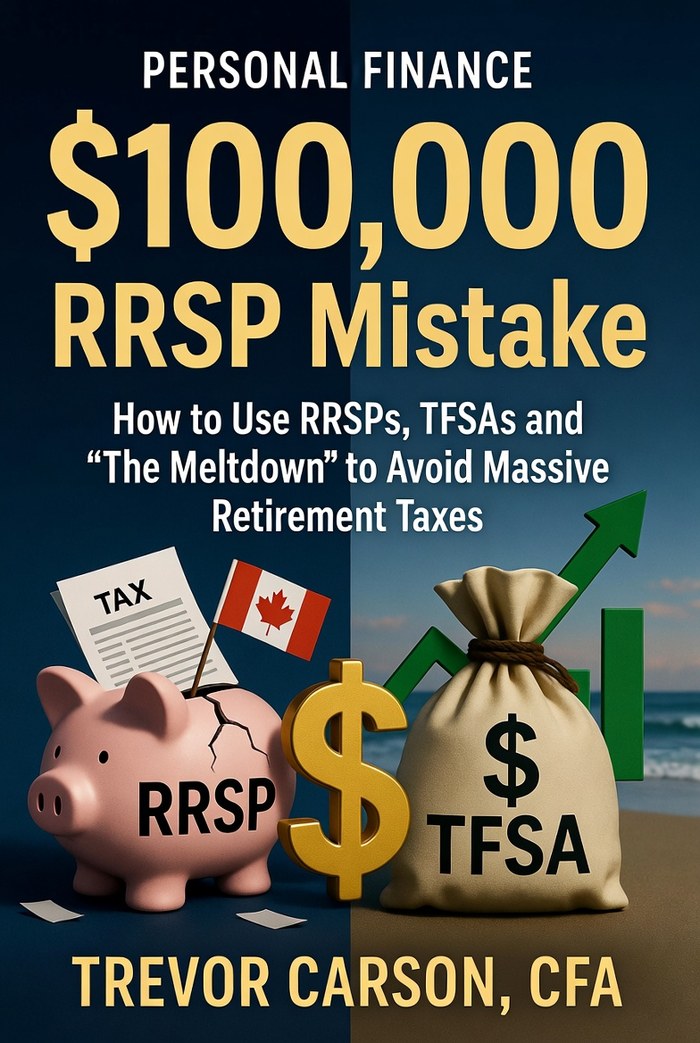
The $100,000 RRSP Mistake cover You're Reading About This One

The $100,000 RRSP & RRIF Mistake

Withdrawal sequencing, the meltdown window, asset location, LIRA unlocking, and keeping RRIF minimums clear of the OAS clawback — the drawdown decisions between 55 and 71.

Buy on Amazon.ca →
Kindle · Paperback · Audible
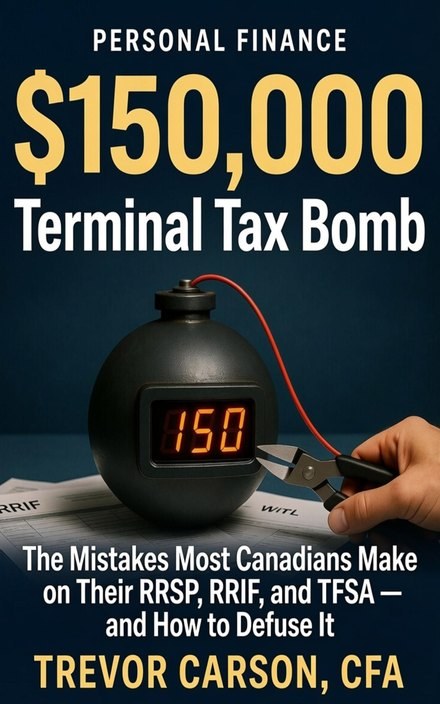
The $150,000 Terminal Tax Bomb cover New — Out Now

The $150,000 Terminal Tax Bomb

What the spousal rollover defers rather than erases — beneficiary design, the second-death projection, donation credits, and second-to-die insurance.

Buy on Amazon.ca →
Kindle · Paperback · Read more about book two
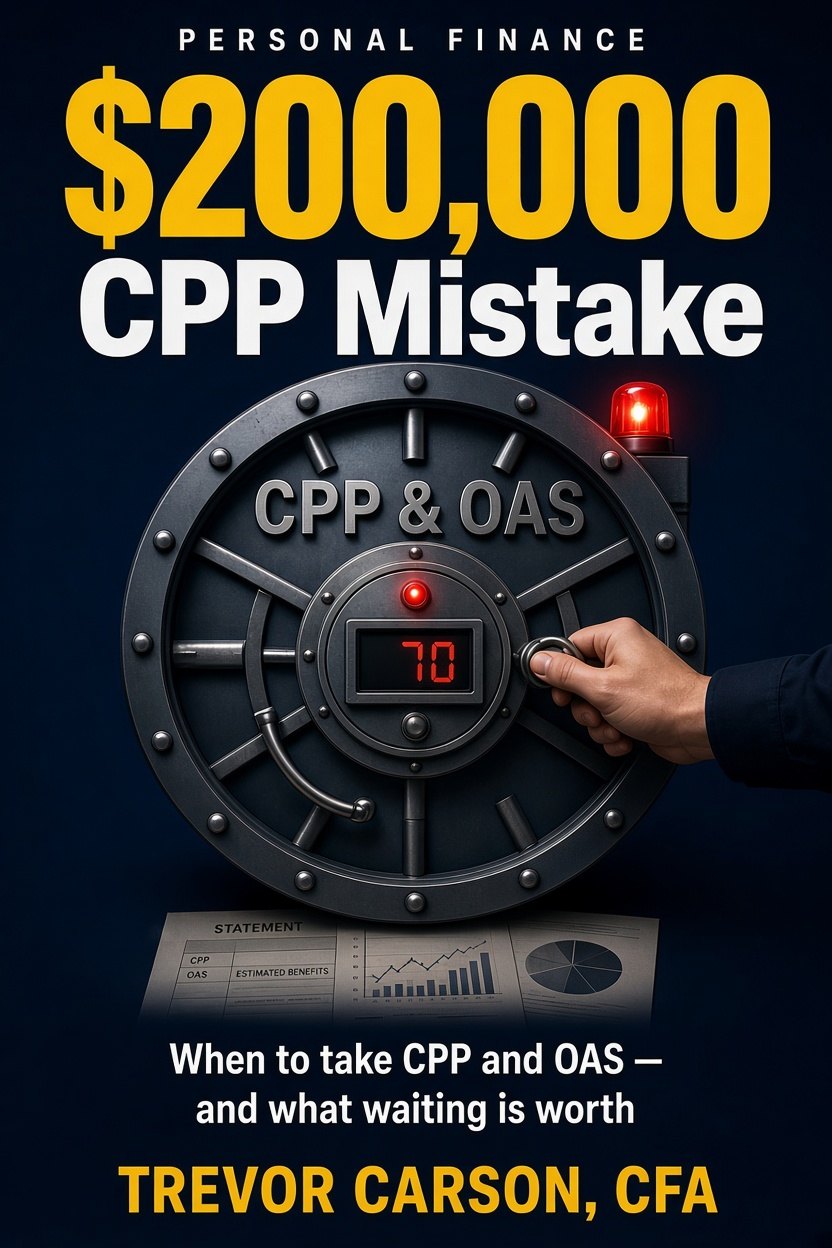
The $200,000 CPP Mistake cover New — Out Now

The $200,000 CPP Mistake

The adjustment math, why breakeven is the wrong question, OAS as a separate decision, survivor benefits and the combined-benefit ceiling — the start-date decision between 60 and 70.

Buy on Amazon.ca →
Kindle · Paperback · Read more about book three
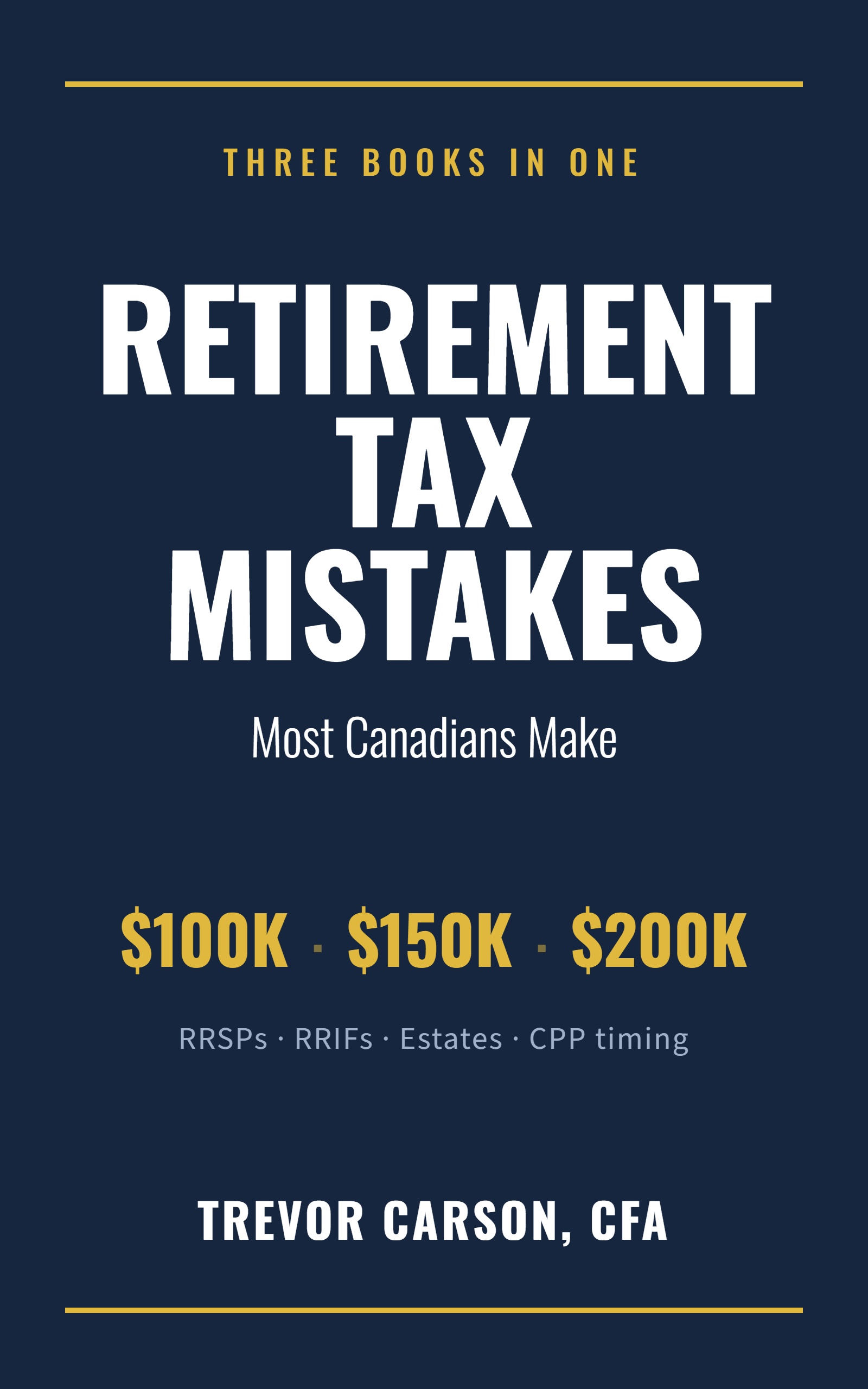
Retirement Tax Mistakes Most Canadians Make — collected edition cover
Collected Edition

Retirement Tax Mistakes Most Canadians Make

All three books in a single 278-page volume — drawdown sequencing, CPP and OAS timing, and tax at death. Three books for the price of two.

Get All Three — $34.99 →
Kindle · Paperback
Trevor Carson, CFA
About the Author

Trevor Carson, CFA

Trevor is a CFA charterholder based in Calgary, Alberta. He wrote this book — and built the free meltdown calculator — because the drawdown side of retirement planning is where Canadian households lose the most money, and where the least plain-language guidance exists.

He isn't selling investment products or advisory services. The book, the math, and the calculator are the whole offer.

FAQ

Frequently Asked Questions

Straight answers to the questions Canadians ask most about RRSP meltdowns, RRIF conversion, LIRAs, and retirement tax planning.

What is the RRSP meltdown strategy?

The RRSP meltdown is the deliberate withdrawal of RRSP funds before mandatory RRIF conversion at 71 — usually during the low-income years after retiring but before CPP and OAS begin. Drawing money out at a lower marginal rate now, rather than a much higher rate later, can reduce lifetime tax by tens of thousands of dollars.

When must I convert my RRSP to a RRIF?

You must convert your RRSP to a RRIF by December 31 of the year you turn 71. The conversion itself is not a taxable event, but mandatory minimum withdrawals begin the following year and are fully taxed as ordinary income.

What is the RRIF minimum withdrawal at age 71?

At age 71, the CRA-prescribed minimum RRIF withdrawal is approximately 5.28% of the account balance, rising each year to 20% by age 95. You can always withdraw more than the minimum, but never less.

What should I do with a LIRA from a former employer?

Many LIRAs sit forgotten in a former employer's default balanced fund charging 2%+ MER. Most provinces allow unlocking provisions — such as converting to a LIF at 55 with a one-time 50% unlock — that give you more control and let you move to lower-cost investments.

What is the OAS clawback threshold?

The OAS clawback (Recovery Tax) begins at $95,323 of net income for the 2026 income year and claws back 15 cents of OAS per dollar above that threshold, eliminating OAS entirely at the upper end. Large RRIF withdrawals stacked on CPP and OAS are the most common trigger.

How does a spousal RRSP reduce taxes?

A spousal RRSP lets the higher-earning spouse contribute using their own deduction room while the account — and eventual withdrawals — belong to the lower-earning spouse. Equalizing retirement income this way can reduce combined household tax by tens of thousands over retirement.

Should I hold bonds in my TFSA or my RRSP?

Bonds and other interest-generating assets are best held inside an RRSP or RRIF, where the interest isn't taxed until withdrawal. High-growth equities are generally better suited to a TFSA, since that growth is permanently tax-free — this placement decision is called asset location.

What is the Guaranteed Income Supplement (GIS)?

The GIS is a non-taxable monthly benefit for lower-income seniors already receiving OAS, reduced by 50 cents for every dollar of net income above the threshold. Because RRSP and RRIF withdrawals count as income but TFSA withdrawals don't, account choice matters enormously for GIS-eligible retirees.

How do CPP and OAS affect my withdrawal plan?

They set the floor your withdrawals stack on top of. Once both are running, every RRSP or RRIF dollar you draw sits above that floor and is taxed at the higher rate — which is exactly why the years before they start are the cheapest years to melt an RRSP down. This book plans the drawdown around whatever start dates you choose. Choosing those dates is a separate decision with its own arithmetic, covered in The $200,000 CPP Mistake.

Is this book financial or tax advice?

No. The book and calculator are for general educational purposes and illustrate concepts using approximate figures. They are not a substitute for advice from a qualified financial planner, tax advisor, or lawyer familiar with your specific situation.
The Strategies That Save the Most Need the Most Lead Time

The meltdown window, the spousal RRSP, the LIRA unlock — each becomes less valuable with every year it's postponed. The best time to understand them is before you retire, not after.

Book cover
Get the Book
Kindle & paperback · Amazon.ca
Buy on Amazon →
For informational purposes · Consult a qualified advisor for your specific situation

Already read it? Leaving a short review on Amazon does more for a self-published book than anything else — and takes about ninety seconds.

Get in Touch

Questions About the Book?

A question about a strategy, a bulk order, a media inquiry — send a message and Trevor will get back to you personally.

Your information is never shared or sold.